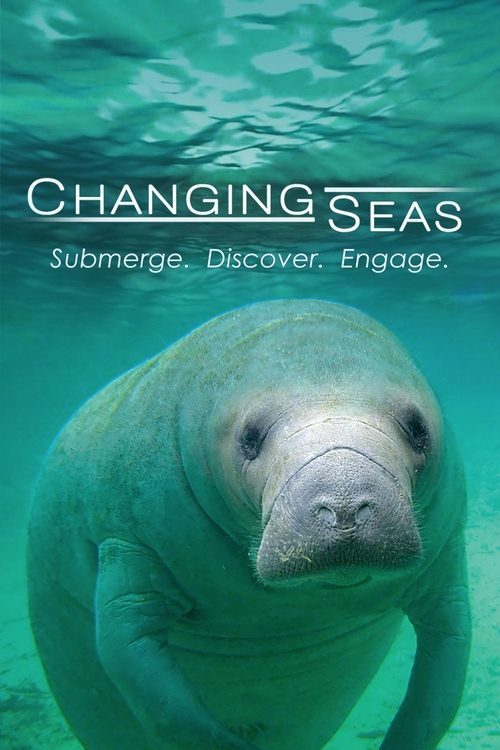
Changing Seas
2009
📺 14 Seasons
🎬 56 Episodes
📅 Returning Series
🌐 EN
⏱️ 27 min/episode
Documentary
Produced by South Florida PBS in Miami, Florida, Changing Seas gives viewers a fish-eye view of life in the deep blue. Join scientists as they study earth’s last frontier and discover the mysteries of our liquid planet.
Where to Watch (US)
Stream
 Magellan TV
 Xive TV Documentaries Amazon Channel
 Thirteen
Seasons
Season 1
At a time when large fish are rapidly disappearing from the world's oceans, one giant is making a comeback in Florida. The Goliath Grouper was facing extinction when it became a protected species in 1990. Since then, the population has had a chance to recover. Now, some members of the recreational fishing community are pushing to re-open the fishery. But scientists studying the colossal, slow-to-mature fish say such a move would be premature. Changing Seas joins scientists in the field to learn more about the life history of these awe-inspiring fish.
Season 2
How do you count two fish, three fish or even a school of fish? In Dry Tortugas National Park, located 70 miles from Key West, Florida, a group of scientists have joined forces to conduct a massive fish census. In this unprecedented collaboration, experts from four different agencies unite to count and analyze fish data from select sites. Changing Seas follows highly-skilled science divers as they determine the size of fish populations in hopes of better understanding how fishing pressures and environmental changes affect populations of marine resources within the park.
Season 3
In the waters of the western Atlantic and Caribbean, a voracious alien predator has taken hold. Native to the Indo-Pacific, the invasive lionfish is a major threat to biodiversity.
Season 4
Sharks are beleaguered species. The oceans' most formidable apex predators are overfished worldwide for their fins, which are considered a delicacy in many Asian countries. Shark populations have declined by up to 90 percent in some cases. But much is still unknown about the animals. Tiger sharks in particular display behaviors that are not well understood. Known to travel long distances, these fish have a broad diet and spend time in shallow, near-shore habitats as well as the depths of the open ocean. Scientists use satellite tags and DNA forensic tools to better understand their migration patterns. Such information is crucial for resource managers to make more informed fisheries management decisions in the future.
Season 5
While Elkhorn and Staghorn corals have undergone a drastic decline in the Caribbean, their hybrid, "Fused Staghorn," is increasing in numbers in parts of the region. One scientist is studying the animals in Belize to see if the hybrid might be better equipped to deal with environmental stressors than its parents.
Season 6
Crinoids have been around in various forms since before the age of dinosaurs. Now experts descend into the deep to study the animals from a submersible.
Season 7
After sea turtle hatchlings emerge from their nests, they vanish into the sea. Until recently, their journey was largely shrouded in mystery. Now, as technology advances, researchers are beginning to understand where turtles go during their so-called “lost years.”
Season 8
Until recently there was scientific consensus that sponges were the first animals to branch off the “Animal Tree of Life,” a kind of family tree for all living and extinct animals on earth. But recent DNA research has cast doubt on that theory, with some scientists suggesting that ctenophores, also known as comb jellies, are an older lineage.
Season 9
Scientists work with the private sector to develop sustainable offshore aquaculture.
Season 10
Dr. Denise Herzing has dedicated her career to studying wild Atlantic spotted dolphins in the Bahamas. She researches the animals’ social structure, behaviors and communication. Now modern technology is making it possible to correlate the dolphins’ sounds and behavior, bringing experts closer to decoding dolphin communication.
Season 11
California’s north-central coast is famous for its natural splendor. Only fifty miles northwest of San Francisco’s Golden Gate Bridge lies the Cordell Bank, a magical underwater island few people have ever heard of. Protected inside a National Marine Sanctuary, this oasis is an ecological hot spot for marine life - attracting birds, sea turtles and marine mammals from thousands of miles away.
Season 12
Scientists explore mysterious blue holes scattered throughout the Gulf of Mexico.
Season 13
Shore-based, catch and release shark fishing is a popular past time in Florida. But is it having a negative impact on sensitive shark populations? Scientists have teamed up with anglers to study the survival rates of the fish and conduct outreach on best practices.
Season 14
The humpback whale population that migrates between Hawaii and Alaska is considered a conservation success story. When sightings of the animals suddenly dropped, people became concerned. Scientists in both locations are trying to understand what happened to the whales and why.

Crew
Writer
Alexa Elliott
Producer
Alexa Elliott
Network
PBS
Production
South Florida PBS, Symbio Studios
Keywords
oceanseanatureoceanography